
A New Window on the Extreme Universe
Four Giant Telescopes Inaugurated at CTAO-North on La Palma, Spain
Four giant telescopes designed to observe some of the most energetic and violent phenomena in the Universe were inaugurated today at the Roque de los Muchachos Observatory on La Palma in the Canary Islands.
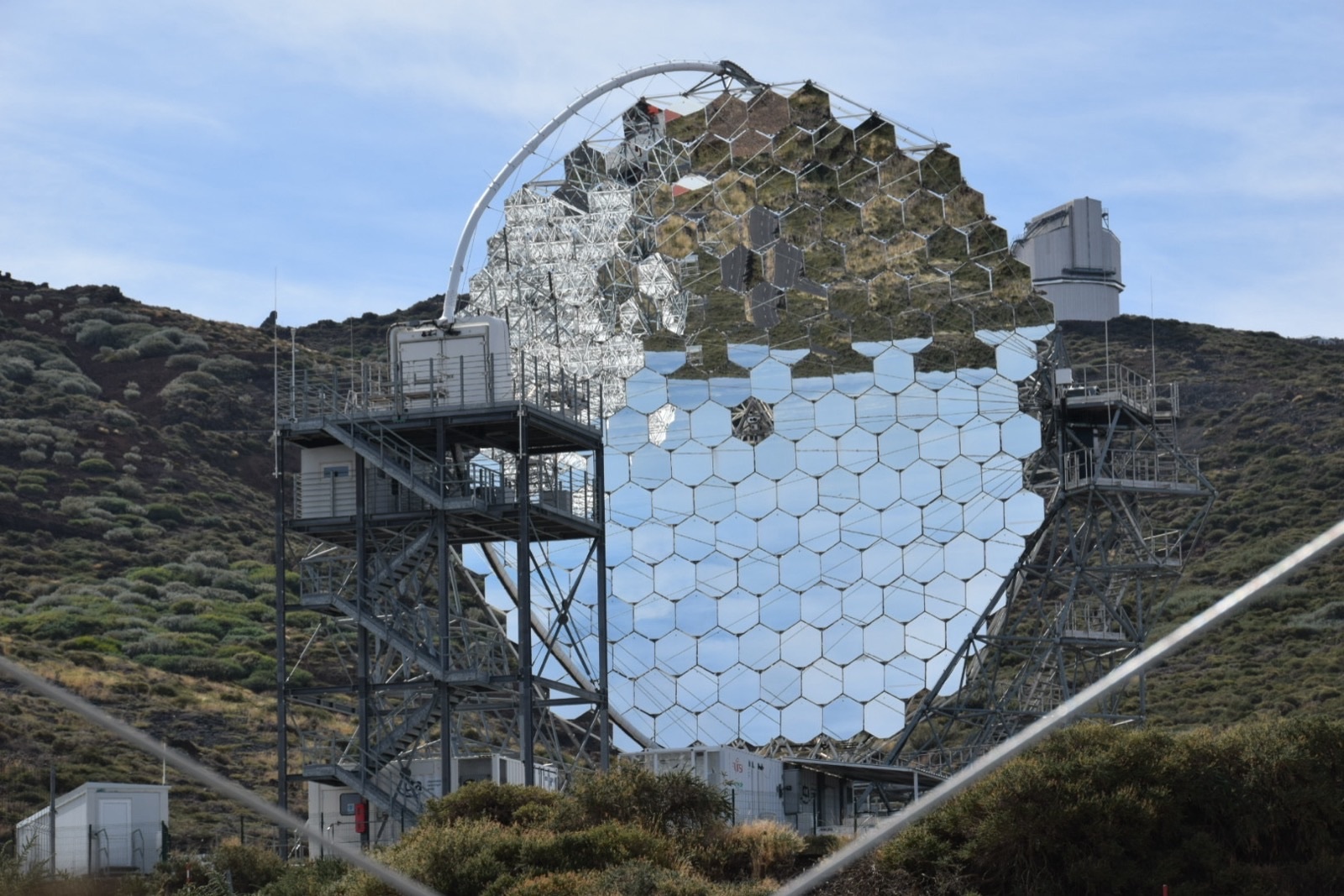
The new Large-Sized Telescopes (LSTs) mark a major milestone in the construction of the Cherenkov Telescope Array Observatory (CTAO), which will become the world's largest and most sensitive ground-based observatory for high-energy gamma-ray astronomy. Slovenia is one of the founding member countries of CTAO ERIC, the international organization responsible for constructing and operating the observatory. Researchers from the University of Nova Gorica and the Jožef Stefan Institute contribute to both the observatory's scientific programme and its technological development.
From exploding stars and rapidly rotating neutron stars to supermassive black holes, the Universe hosts extraordinarily energetic processes capable of accelerating particles to energies far beyond those achievable in laboratories on Earth. Many of these processes produce gamma rays, the most energetic form of electromagnetic radiation. Their observation allows astronomers to investigate the cosmic accelerators responsible for producing high-energy particles, study the environments surrounding black holes, and search for clues about the nature of dark matter.
The four LST telescopes, each equipped with a 23-metre-diameter reflector, detect extremely faint flashes of light produced when gamma rays interact with Earth's atmosphere, creating showers of secondary particles. These flashes, known as Cherenkov radiation, last only a few billionths of a second. By observing the same particle showers from different positions, the telescopes can reconstruct the direction and energy of the incoming gamma rays. The LSTs are particularly sensitive to lower-energy gamma rays, making it possible to study distant cosmic sources whose higher-energy radiation is absorbed during its journey through the Universe. Despite their enormous size, the telescopes can reposition in less than 20 seconds, allowing them to respond rapidly to unpredictable events such as gamma-ray bursts and other cosmic explosions.
Slovenian scientists have participated in the international CTA Consortium since 2013, contributing to the observatory's scientific strategy and preparations for its research programme. Their work addresses fundamental questions, including the origin of high-energy cosmic particles and the nature of dark matter, which makes up much of the matter in the Universe but has so far escaped direct detection. Researchers from the University of Nova Gorica and the Jožef Stefan Institute develop observational strategies and advanced data-analysis methods, including artificial intelligence and machine learning, to identify and study high-energy gamma-ray sources. Their research also aims to combine future CTAO observations with information from other observatories studying cosmic rays, neutrinos and gravitational waves. This approach, known as multi-messenger astronomy, allows scientists to investigate the same cosmic phenomena through different types of signals, providing a more complete picture of the physical processes involved.
Slovenia also contributes to the technological development of CTAO through an advanced Raman lidar system designed to monitor atmospheric conditions above the observatory on La Palma. The Earth's atmosphere is effectively part of the gamma-ray detector: it produces the Cherenkov light observed by the telescopes, but changes in its transparency can also affect the measurements. Accurate knowledge of atmospheric conditions is therefore essential for determining the energies of incoming gamma rays. Raman lidar uses laser pulses to measure atmospheric properties, providing information needed to correct telescope observations. Researchers from the University of Nova Gorica and the Jožef Stefan Institute are developing the instrument together with partners from Spain and Italy. Following successful prototype testing at La Palma, work is progressing on the final system, which is being prepared as a joint technological contribution to CTAO.
"Breakthrough discoveries in modern astrophysics increasingly rely on combining observations across different wavelengths and using different cosmic messengers, such as photons, neutrinos, cosmic particles and gravitational waves. CTAO represents an important step in this direction, providing a new level of sensitivity to high-energy gamma rays. Slovenia's participation gives our researchers the opportunity to contribute both to the development of this observatory and to the scientific discoveries it will enable," said Prof. Samo Stanič, Slovenia's representative in the CTAO ERIC Council and Head of the Center for Astrophysics and Cosmology at the University of Nova Gorica.
Slovenia became a founding member of CTAO ERIC in January 2025, when the European Commission established the international organization responsible for constructing and operating the observatory. Slovenian participation is supported by the Ministry of Education, Science and Youth through the national research infrastructure development programme.
The four inaugurated telescopes form the low-energy core of CTAO-North. The first, LST-1, has already been conducting scientific observations, while the other three are entering their commissioning phase. Once completed, CTAO will comprise more than 60 telescopes at two sites: CTAO-North on La Palma and CTAO-South in Chile's Atacama Desert. Their complementary capabilities will allow astronomers to study gamma-ray sources across a broad energy range and over practically the entire sky, making an important contribution to the development of multi-messenger astronomy.