
About
Mission & Research Focus
The Center for Astrophysics and Cosmology (CAC) at the University of Nova Gorica (UNG) is a vibrant hub for high-energy, multi-messenger astrophysics research. As the largest Slovenian research group in this field, CAC plays an active role in a number of international collaborations, trains the next generation of researchers, and strongly engages in public outreach. In doing so, it not only pushes the boundaries of fundamental science but also strengthens Slovenia’s presence in global research activities. CAC aims to apply the multi-messenger approach – combining information carried by different cosmic messengers such as photons, charged particles, neutrinos, and gravitational waves – to reveal high-energy phenomena and fundamental processes. This approach is further enhanced by the use of advanced machine-learning techniques. The center’s research focuses on the sources and properties of ultra-high energy cosmic rays, transient astrophysical phenomena (including gamma-ray bursts, neutron star/black hole mergers, and tidal disruption events) and dark matter physics and the matter-antimatter asymmetry of the Universe.
Location & Team
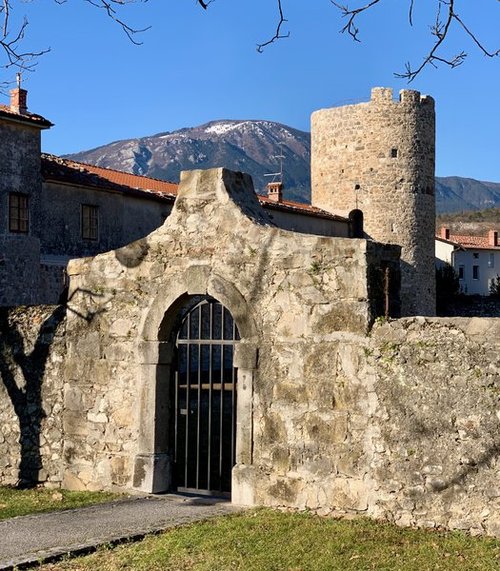
CAC is located on the UNG campus in Ajdovščina, in the Vipava Valley of southwestern Slovenia, close to the Italian border. Ajdovščina is a rapidly growing industrial hub, hosting high-tech businesses in aeronautics, the food industry, and chemical engineering. Ajdovščina boasts rich history, dating back to the days of the Roman Empire. Around the year 270 AD, the Romans erected a fortress with defensive towers on its grounds, known as Castra ad Fluvium Frigidum (fortress at the Cold River – Hubelj), which formed a part of an Ancient Roman defensive system known as Claustra Alpium Iuliarum. A pivotal historical event was the Battle at Frigidus on September 5th and 6th, 394 AD, between today's Vrhpolje and Ajdovščina. Assisted by powerful Bora wind, the Eastern Roman Emperor Theodosius emerged victorious over the Western Roman throne usurper, Eugenius. This strategic location enables close collaboration with Italian institutions, including SISSA, ICTP, and Università degli Studi di Trieste.
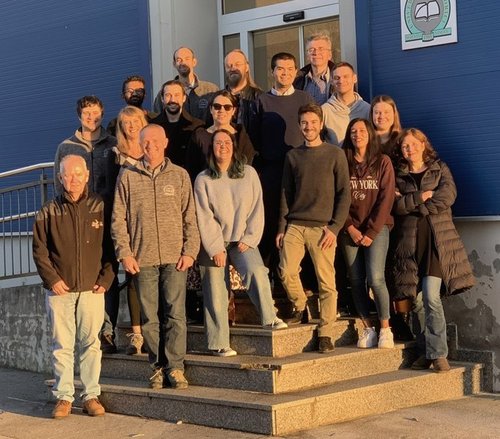
The CAC team comprises of permanent faculty members, postdoctoral researchers and PhD students, forming a vibrant and interdisciplinary research community.
Major Projects & Collaborations
The center is involved several prominent international projects, including the Cherenkov Telescope Array Observatory, Pierre Auger Observatory, Vera C. Rubin Observatory, Fermi-LAT, Gaia, Liverpool Telescope, and ENGRAVE. CAC leads the Marie Sklodowska-Curie COFUND project SMASH, within which novel machine-learning applications for science and the humanities are being developed, and through the TALES Doctoral Network, the center hosts a PhD student investigating tidal disruption events using Rubin Observatory data and advanced machine-learning techniques.
Teaching & Public Outreach
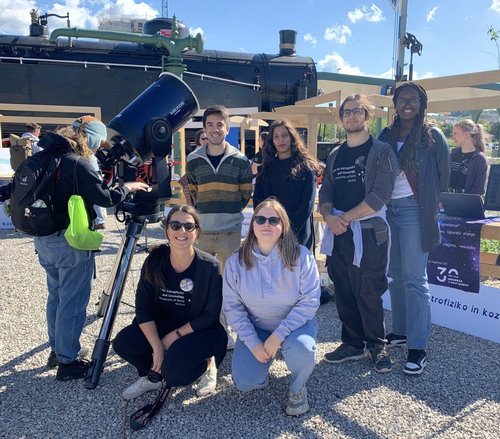
CAC faculty teach at both the School of Science and the Graduate School of UNG. It supports early-career researchers through PhD student positions, postdoctoral fellowships, and participation in global observatories. The center engages in public outreach and education, including initiatives such as GoChile, Slovenia’s first telescope in Chile, which is being operated under Open Science principles and is accessible to university and high school students as well as amateur astronomers.
Strategic Vision & Future Plans
Looking ahead, CAC aims to further expand its multi-messenger astronomy research - combining cosmic rays, gamma rays, neutrinos, and gravitational waves to explore extreme astrophysical phenomena - by developing and applying advanced data analysis techniques based on machine learning and modern data science. Specific goals include expanding transient studies using Rubin Observatory LSST data, enhancing education and training programs, and increasing its contribution to the infrastructure of international observatories as well as national capabilities in astrophysics.