
International conference AI for Science
AI for Science – From 22 to 26 September 2025, Ljubljana, Slovenia, will host one of the most comprehensive European scientific events on artificial intelligence for science
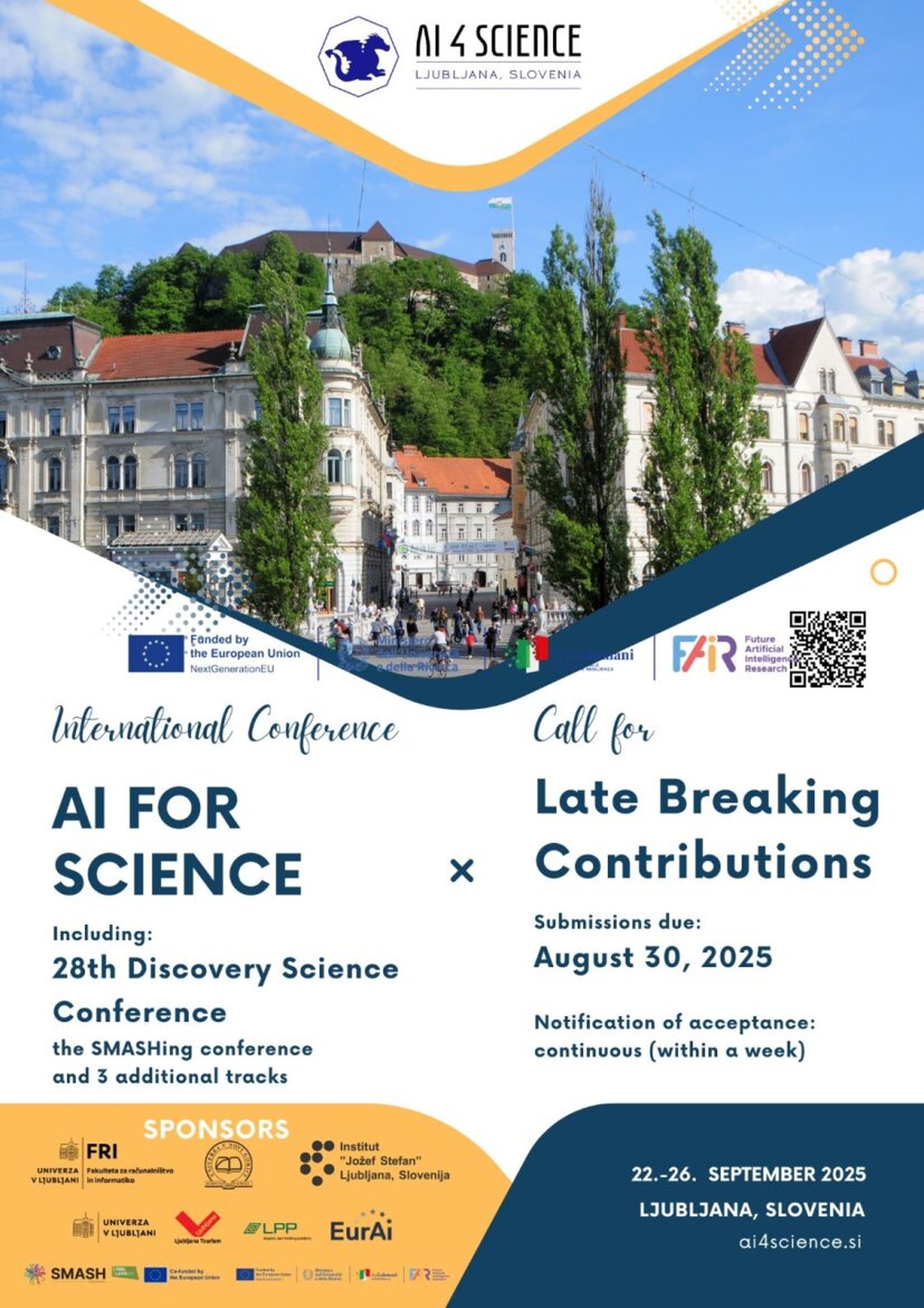
From 22 to 26 September 2025, the Faculty of Computer and Information Science at the University of Ljubljana will host the international conference AI for Science, co-organised by the Faculty of Computer and Information Science, University of Ljubljana (UL FRI), the Jožef Stefan Institute (IJS), and the University of Nova Gorica (UNG), in collaboration with the Slovenian Artificial Intelligence Society (SLAIS).
AI for Science is poised to become one of the most comprehensive scientific events in Europe focused on artificial intelligence (AI) in science. The conference will bring together top domestic and international experts who apply AI to tackle complex scientific and technological challenges. The programme builds upon the 28th edition of the renowned Discovery Science conference and expands it with a series of specialised tracks covering a broad spectrum of research fields – from physics and materials science, through life and environmental sciences, to space research and digital humanities. The main programme will be accompanied by satellite events addressing AI factories, responsible AI, and scientific policies in the field of AI for science.
The conference will also highlight scientific results from the project SMASH (Machine Learning for Science and Humanities) – an exceptional European postdoctoral programme that brings together five leading Slovenian research institutions and more than 40 national and international partners. SMASH enables 50 top postdoctoral researchers from around the world to develop AI-based applications in physics, climate science, medicine, linguistics, and data science, both in Slovenia and abroad.
Why is AI for Science important?
Artificial intelligence is becoming a key accelerator of scientific progress. Generative AI, deep learning, and other advanced machine learning techniques increasingly enable discoveries that augment human insight in data analysis, pattern recognition, and the simulation of complex systems. Today, AI plays a crucial role in the development of new drugs, understanding biological structures, early disease detection, environmental modelling, the design of advanced materials, exploration of fundamental physics, and even the analysis of cultural heritage. Its applications are remarkably diverse, shaping how science is conducted and opening up entirely new epistemological questions.
Slovenia on the global AI map: talent, research, and results
Slovenia ranks among the countries with highly accomplished researchers and internationally recognized research teams in artificial intelligence. Groups from the University of Ljubljana, the Jožef Stefan Institute, the University of Nova Gorica, and other institutions actively participate in European and global research projects. They are developing innovative diagnostic tools in medicine, testing AI for spatial modelling, and applying machine learning in physics, social sciences, and the humanities. Many of these findings are already transitioning into industrial use.
The AI for Science conference thus represents an opportunity to present Slovenian expertise, foster international collaboration, and broaden public understanding of both the potential and the challenges of AI in science. It is also a chance to engage the public in a wider dialogue about the societal impact of artificial intelligence, its scientific promise, and our shared responsibility in shaping its