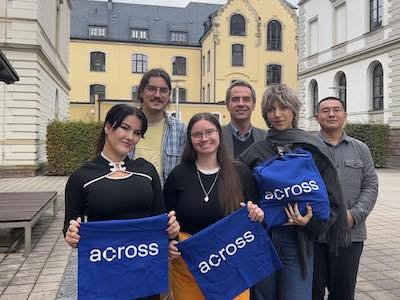
Testimonial of student Neja Vodopivec about the ACROSS seasonal school "Renewable borders: The energy landscape in the European Borderlands" in Chemnitz
As a student of Cultural History at the School of Humanities of the University of Nova Gorica, I had the opportunity, within the framework of ACROSS European Cross-Border University Alliance, of which the University of Nova Gorica is a member – to attend the seasonal school “Renewable borders: The energy landscape in the European Borderlands” in Chemnitz, Germany. The school took place in October 2023 and lasted one week. It brought together students from the University of Nova Gorica as well as from other universities in the network, namely from Italy, Bulgaria, Spain, and Germany.
Students from various study programmes explored the importance of border regions in establishing diverse infrastructure for generating electricity from renewable sources. We approached the topic from several perspectives, focusing on how different countries can collaborate on setting up energy infrastructure in border areas where cross-border cooperation and connectivity are being enhanced. We examined two case studies: the first concerned a planned offshore wind farm on the northeastern coast of Spain near Girona, which is problematic mainly from an environmental standpoint, as it would significantly affect the natural biosphere. The second case study focused on a project to build a solar power plant in the Friuli Venezia Giulia region in Italy, near the border with Slovenia.
Both examples revealed certain advantages; the greatest one is the cooperation between countries aimed at improving the supply of electricity generated from renewable sources. On the other hand, we gained a deeper understanding of the negative aspects of energy production. Even though these methods are considered more environmentally friendly, they are not as clean as we tend to think or wish. To meet the growing demand for electricity from renewable sources, large areas are required, which leads to the destruction or permanent alteration of the natural biosphere. The materials used to produce wind turbines or solar panels are not environmentally friendly, as they cannot yet be recycled, meaning that once they reach the end of their lifespan, they end up in landfills.
This experience was very interesting and educational, as it brought together students from different study fields and countries, who built a small mosaic of perspectives in exploring the issues of border regions and renewable energy production. Together we successfully tackled the challenge and demonstrated that such projects may require interdisciplinary collaboration, as only this allows for a comprehensive understanding of a given topic or issue. ACROSS is therefore a network that enables students to discover new places and people and to learn in a slightly more informal way than through traditional university lectures. I would recommend anyone who has the opportunity to participate in a summer school within the ACROSS European Cross-Border University Alliance.
Neja Vodopivec, undergraduate student of the study programme Cultural History, School of Humanities, University of Nova Gorica