
e-UNG
By introducing elements of e-learning we enable our students to study in a modern and more flexible way. Consult individual UNG schools for further details.
Study and e-UNG
By introducing elements of e-learning we enable our students to study in a modern and more flexible way.
All study programmes at the University of Nova Gorica have the possibility of using Moodle virtual classrooms in combination with face-to-face teaching. In addition to this, the collaborative platform MiTeam is being introduced.
Login to Moodle
- School of Science (info.fn@ung.si)
- School of Engineering and Management (info.ptf@ung.si)
- School of Humanities (info.fh@ung.si)
- School of Environmental Sciences (info.fzo@ung.si)
- School for Viticulture and Enology (info.vsvv@ung.si)
- School of Arts (info.au@ung.si)
- Graduate School (info.fps@ung.si)
Login to MiTeam
If you have already received and confirmed the password for MiTeam, enter here.
New users:
- teachers please contact the school secretary to be connected with the school MiTeam coordinator;
- students will be invited by e-mail to use the platform at particular courses (by agreement with their teacher);

E-UNG
Open education
Video lectures and other open learning contents represent excellent resources of knowledge for everyone interested in various areas of study and research at the University of Nova Gorica.
Open education for a better world
University of Nova Gorica (UNG) and UNESCO Chair on Open Technologies for OER and Open Learning at the Jožef Stefan Institute (JSI) have initiated and together implemented the Open Education for a Better World (OE4BW) international on-line mentoring programme. More than 300 projects involving 447 participants from 40 countries were included in the last six years. The program was also awarded with Open Collaboration Award of Excellence.
Open Education for a Better World (OE4BW) subsequently evolved into the Master’s programme Leadership of Open Education. The mission of this programme is to educate students from developing countries and from regions where access to subscription-based scientific journals and prohibitively priced academic books is limited, or where individuals are unable to afford authors’ publication charges (APCs).
The programme initially received support from UNESCO and the Hewlett Foundation. It now operates independently and without a concession, and tuition fees are payable by students. Nevertheless, in keeping with its longstanding commitment to supporting its students, the University of Nova Gorica offers scholarships through the F-UNG Foundation.
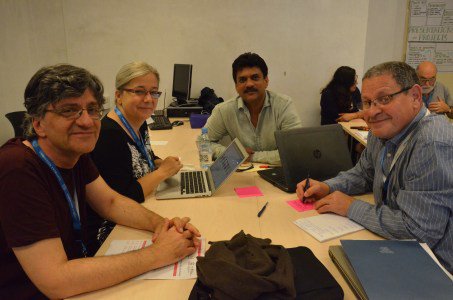
Meeting