
The University of Nova Gorica hosts the second SMASHing workshop
The University of Nova Gorica will host, from 19th to 23rd October 2026, at Lanthieri Mansion in Vipava, the second SMASHing Workshop.
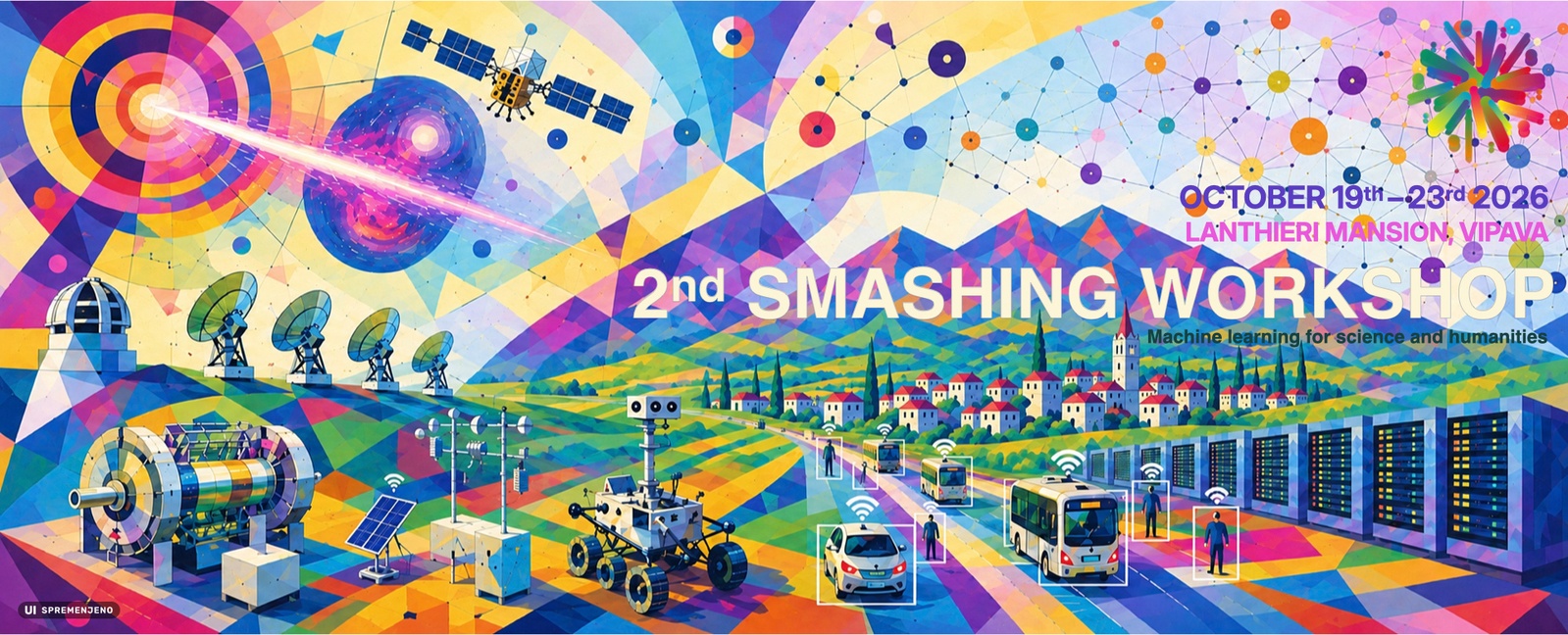
It will gather about 80 international and local scientists working on developing cutting-edge Machine Learning (ML) and Artificial Intelligence (AI) applications for science and humanities.
The workshop will be the third annual meeting of the SMASH network, a project, which is co-funded by the European Commission under the Horizon Europe programme, Marie Skłodowska-Curie Actions (MSCA) COFUND, and by the Republic of Slovenia, Ministry of Education, Science and Youth, and the European Union from the European Regional Development Fund (ERDF). The SMASH programme connects researchers from five leading Slovenian institutions with about 30 academic institutions worldwide, as well as a number of Slovenian companies. It follows our previous events, the First SMASH(ing) Workshop in Vipava in 2024 and the AI for Science Conference in Ljubljana in 2025.
We are bringing together a distinguished group of invited speakers coming from nine EU countries, USA, China and South Africa, whose expertise spans a broad range of AI methodologies and scientific disciplines in which machine learning and AI are making a significant impact. The workshop will combine invited talks with discussions aimed at encouraging exchange between different research fields and identifying opportunities for future collaboration.
The workshop will host also a number of round table and public events:
On Monday, 19th October 2026, starting at 2 PM, we will host an opening ceremony with opening words given by Dr. Boštjan Golob (Rector of the University of Nova Gorica), Dejan Flašker, MA (Acting Director-General, Directorate for Innovation and Digitalisation in Education and Science), Dr. Gregor Majdič (Rector of the University of Ljubljana), Dr. Leon Cizelj (Director of Institute Jožef Stefan), Mojca Dolinar, MA (Director of Meteorology, Hydrology and Oceanography Office, ARSO) and Dr. Aleš Bošnjak (Director of IZUM).
The opening words will be followed by a round table on “Shaping the Future of AI in Science: Funding Strategies and Opportunities”. It will explore how AI is reshaping science and how funding strategies can support this transformation. The discussion will look at both “AI for Science” - using advanced AI methods to accelerate scientific discovery, and “Science for AI”, where complex scientific challenges can help drive the development of more capable AI systems. Panelists from Slovenia, the European Commission, the United States and China will compare approaches to research funding, AI infrastructure, dedicated institutes and public–private collaboration, while also addressing questions of European technological sovereignty, access to models and data, and the need to preserve human understanding and scientific judgement as AI increasingly accelerates the production of scientific results. The panel will ultimately ask what kind of AI-enabled scientific ecosystem we want to build, and what funding mechanisms and incentives are needed to get us there.
Panelists:
- Dejan Flašker, MA, Acting Director-General, Directorate for Innovation and Digitalisation in Education and Science),
- Dr. Jan Jona Javoršek, Jožef Stefan Institute, Head of the Centre for Network Infrastructure and SLAIF Work Package on Outreach and Dissemination),
- Shana Impens, Project Officer at the European Research Executive Agency (REA), managed by the European Commission) (online participation),
- Dr. Sascha Caron, particle physicist, Professor Radboud University. Co-chair for Astronomy and Fundamental Physics of the Horizon Europe-funded SCIANCE project (Shaping AI in Science, by Scientists, for Europe), a coordination and Support Action launched to lay the foundational framework for the RAISE program) (online participation),
- Dr. Jure Zupan, particle physicist, Professor at the University of Cincinnati) and
- Dr. Lili Yang, astroparticle physicist, Professor at Sun Yat-sen University, China).
Moderator: Dr. Gabrijela Zaharijas (astroparticle physicist, Professor at the University of Nova Gorica, coordinator of the MSCA COFUND project SMASH)
On Tuesday, 20th October 2026, starting at 6 PM in the X-center in Nova Gorica, we will host a round table event open to the public on the topic "AI and the future of academia". AI is rapidly changing the way research is conducted, how academic skills are taught and how careers are rewarded. This panel will ask the questions: What shape is academic research and teaching taking in the age of AI: What does it mean to do research - and to undertake training as a student - when allegedly super-human knowledge is all the time at your fingertips?
Panelists:
- Dr. Camille Howson, Professor of Higher Education at Imperial College London, expert in higher education research with a focus on student engagement; student outcomes and learning gain; equality and social justice; and quality, performance and accountability;
- Dr. Jana Javornik, SMASH Ethics Adviser and a founding member of UNESCO’s Women for Ethics of AI, Visiting Research Professor at the Institute of Contemporary History, and a former Director-General of Higher Education. Researches public policy, social and workplace sustainability, EDI, AI ethics, comparative methodology, and knowledge translation;
- Dr. Matjaž Ličer, researcher at the Environment Agency of Republic of Slovenia, expert in oceanography, pollutants and machine learning applications to studies of extreme weather events.
Moderator: Dr. Roberto Trotta, cosmologist and Head of the Theoretical and Scientific Data Science group at the International School for Advanced Studies (SISSA) in Trieste, Italy, where he also serves as Director of the Interdisciplinary Laboratory. He is the author of several popular science books and a prominent voice in the astroparticle physics community, known for critically examining the role and impact of AI in scientific research.
Round table will be conducted in English.
On Wednesday, 21st October 2026, the University of Nova Gorica will host a public lecture as part of its Scientific Afternoons series, entitled “What Will AI Make Us? Smarter or Dumber? More or Less Human?” The lecture will be given by Prof. Dr. Johannes Schneider of the University of Liechtenstein, who will be visiting the University of Nova Gorica as an invited speaker at the SMASHing workshop. While much of the current debate focuses on what artificial intelligence may become, the lecture will turn the question around and ask: what will AI make us? As AI systems become increasingly capable, personalized and embedded in our everyday lives, they may profoundly affect the way we think, learn, relate to others and make decisions. Will AI make us smarter or dumber? Lonelier or more connected? More autonomous or more dependent? Prof. Schneider will first demystify some of the technology behind modern AI and then discuss what scientific research tells us so far about its impact on human thinking, development and relationships. Finally, he will explore how we might shape AI so that it changes us for the better.
More info: https://ung.si/en/news/event/360/what-will-ai-make-us-smarter-or-dumber-more-or-less-human/
Lecture will be given in English.